
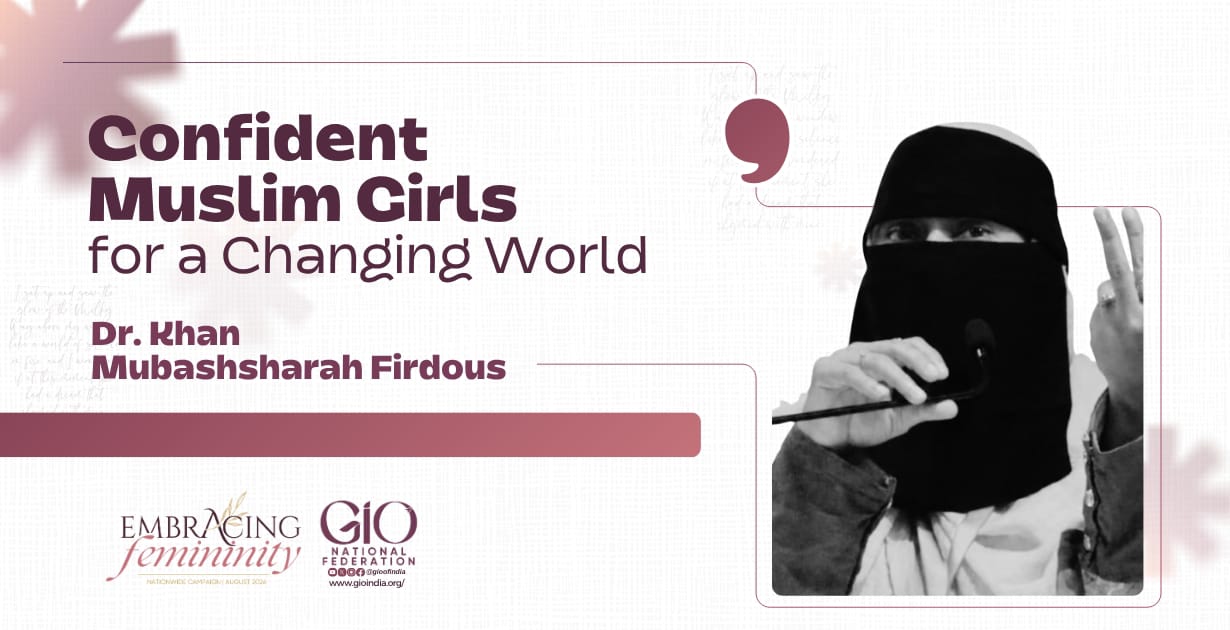
Confident Muslim Girls for a Changing World
At first glance, the condition of women today appears far better than it was in previous generations. Girls have greater access to education, professional opportunities, and platforms to showcase their talents. Muslim women, too, are pursuing higher education and entering diverse fields. Yet beneath this apparent progress lies a growing ideological confusion, particularly among young Muslim women and university students.
On one hand, many are told that a Muslim woman's primary sphere is the home—that her responsibilities begin and end with raising children, managing the household, and serving her family. These expectations are often placed even on women who have invested years in acquiring higher education and professional expertise. It is not easy for a young woman to become a doctor, engineer, researcher, or academic. Many pursue these careers because they are genuinely passionate about them and aspire to serve society through their knowledge and skills.
Parents today also encourage their daughters to become educated and financially capable. The increasing instability of family structures, rising divorce rates, and the insecurity many women experience after marriage have motivated parents to ensure that their daughters are equipped to stand on their own if necessary.
However, once these young women enter colleges and universities, they often encounter an entirely different worldview. Campus culture introduces them to ideological narratives that frequently bear little resemblance to the realities of family life or the balanced framework of Islam. Feminism, in many settings, presents empowerment as liberation from all traditional relationships and responsibilities.
Consider the example of Sarah, a nineteen-year-old university student.
Sarah grew up in a loving Muslim home where she enjoyed every educational opportunity that her brother did. She had her own room, study table, transportation, and complete freedom to pursue her academic interests. Alongside these privileges, she was taught to pray, respect elders, distinguish right from wrong, develop social responsibility, and observe modesty and hijab.
When she entered university, however, she encountered a very different environment. She experienced religious prejudice, became the subject of jokes because of her hijab, and constantly felt like the "odd one out." She faced criticism about everything—from her clothing to her appearance—and slowly began questioning everything she had been taught.
What does women's empowerment really mean?
What does democracy actually promise?
Where is freedom of choice?
Are my parents too restrictive?
Is religion holding me back?
Should I become an "independent woman" by distancing myself from my family?
Social media further intensified this confusion. Trends promoting ideas of patriarchy convinced her that society is built upon the oppression of women. Corporate culture glamorised absolute individualism. Peer pressure rewarded conformity. Online influencers portrayed marriage as a burden and independence as the only path to happiness.
As a result, many young women today aspire to successful careers but simultaneously fear marriage and family life. Household responsibilities appear overwhelming, and balancing both seems impossible.
How did we reach this point?
Was this simply the result of outside ideological influence?
Partly—but not entirely.
The uncomfortable truth is that many Muslim societies have failed to practice the rights that Islam itself granted women fourteen centuries ago.
Marriage, in Islam, is intended to be a source of security, protection, affection, and tranquility. The Qur'an presents it as a relationship built upon mutual mercy and companionship. Yet in many cultures, women experience marriage as a system of control rather than compassion.
In some families, a woman feels unable to express her opinions. She has little say in family decisions. Although Islam grants her complete ownership of her wealth, in practice she is often expected to surrender financial control. Childcare is treated as her sole responsibility. Caring for elderly relatives becomes exclusively her duty. Even her identity is sometimes diminished—wedding invitations may identify her only as "the daughter of..." rather than by her own name.
These practices are not Islamic; they are cultural. Unfortunately, when culture is mistaken for religion, young women begin associating Islam with injustice.
The Qur'an, however, makes no distinction between men and women in terms of spiritual worth or accountability. It declares:
For men is a share of what they have earned, and for women is a share of what they have earned.
(Qur'an 4:32)
The life of the Prophet (PBUH) further demonstrates that women were encouraged to contribute according to their individual strengths and interests.
Asma bint Abu Bakr (RA) actively supported the Prophet (PBUH)during the Hijrah, secretly delivering food to him in the Cave of Thawr and later participating in public affairs. Her personality naturally inclined toward outdoor responsibilities, and this was never discouraged.
Fatimah (RA), on the other hand, devoted herself to nurturing her family and serving guests. Her contribution reflected her own strengths and circumstances. She was never expected to imitate other women.
Aisha (RA) became one of the greatest scholars in Islamic history. Thousands of scholars learned from her, and her lifelong contribution was education and intellectual leadership.
Zaynab bint Jahsh (RA) earned through her craftsmanship by tanning leather and making water skins, using her income to support widows, orphans, and the poor. Upon her death, Aisha (RA) remarked that many needy households had lost a source of support because of her generosity.
Umm Atiyyah (RA) was known for preparing and selling perfumes.
Each Companion contributed according to her unique abilities. Islam never imposed a single model of womanhood upon every woman.
Likewise, women differ in their personalities and talents. Some excel in homemaking. Others thrive in teaching, medicine, research, entrepreneurship, writing, counselling, or social work. Yet our communities often judge women by only one standard: whether they perfectly manage every domestic responsibility regardless of their circumstances.
Even Aisha (RA) was not remembered primarily for domestic perfection. Her greatness lay in her scholarship, wisdom, and contribution to the Ummah. The Prophet (PBUH) never diminished her confidence because she was not known for household management. Umar ibn al-Khattab (RA) frequently sought the advice of his wife, recognising her wisdom and judgment.
Sadly, discussions about women are often reduced to isolated slogans: "A woman's testimony is half," "A woman's inheritance is half," or "Women are deficient in intellect." These statements are frequently quoted without explaining their legal context, wisdom, or objectives. Such superficial presentations distort Islam's image and unintentionally strengthen secular feminist narratives that portray Islam as inherently unjust to women.
As a result, many Muslim girls are pushed toward alienation from their faith—not because of Islam itself, but because Islam is poorly represented.
The Qur'an beautifully distinguishes between biological responsibilities and human potential. Men and women have different natural strengths, yet both are equally capable of serving society and earning Allah's pleasure.
Allah has placed exceptional compassion and nurturing qualities within mothers because young children require that care. He has generally entrusted men with the financial responsibility of supporting the family. These complementary roles are responsibilities—not measures of superiority.
Understanding this balance transforms a Muslim woman's confidence.
Islam does not obligate a woman to financially provide for herself or her family. That responsibility rests upon her husband. Whatever wealth she earns remains entirely her own. Islam granted women property rights, inheritance rights, educational rights, and the freedom to participate in society centuries before many modern legal systems recognised them.
The Qur'an also describes believing men and believing women as partners in building a righteous society:
The believing men and believing women are allies of one another.
(Qur'an 9:71)
This partnership reflects mutual responsibility, cooperation, and shared moral purpose—not competition.
When Muslim girls understand these principles deeply rather than superficially, their confidence grows. They no longer feel compelled to choose between faith and ambition. They realize that Islam encourages them to pursue knowledge, excel in their chosen fields, build strong families, contribute to society, and worship Allah—all at the same time.
True empowerment is not abandoning one's faith or family. True empowerment is understanding the dignity, purpose, and rights that Allah has already granted—and living them with confidence, wisdom, and balance.
Dr. Khan Mubashsharah Firdous
Dr. Khan Mubashsharah Firdous is an Aalimah, educationist, writer and trainer, currently serving as the Assistant Secretary at Jamaat-e-Islami Hind (JIH).