
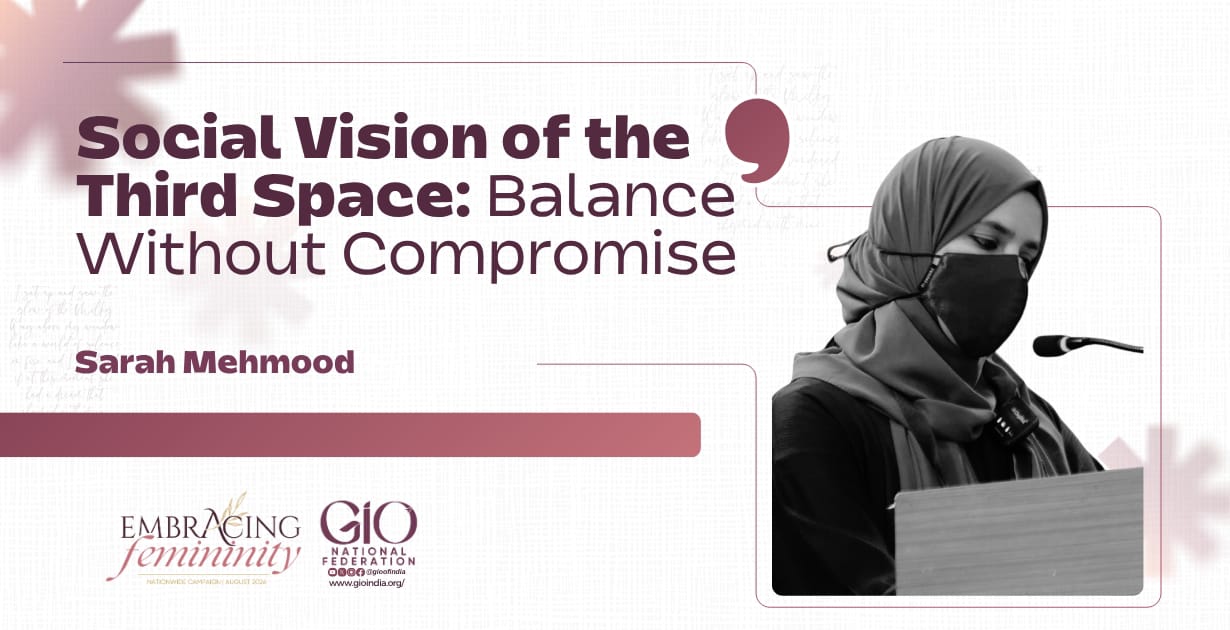
The Social Vision of the Third Space: Balance Without Compromise
She’s either too much or too little,
Too loud or too silent.
She’s either strong or someone to belittle,
Either too dependent or self-reliant.
She can either have a career or a family,
It's either dunya or deen.
Choose between splendour and modesty,
Be submissive—or be labelled mean.
But beyond these polarised narratives
Is a woman with purpose and vision,
Who cannot be confined to narrow perspectives.
She may be gentle, yet she's on a mission.
The poem is the first few lines I penned as I reflected on today's theme. As society continues to place women into boxes, I’ve often found myself asking, who decided that women had to juggle every role and yet somehow never be enough? Or worse still, who decided that a woman was destined for just one role, only for her to suppress her talents and quietly bury her dreams?
As a writer of Spiritual Fiction, one question I'm often asked is whether my books are my own story. The answer is no. But I will admit that the women in my books are inspired by those in my own life. Looking back, I realise that the women who shaped me never lived divided lives.
My grandmother owned a business at a time when very few women did. Her customers knew her not simply for making the best preserves, but as a woman of warmth, a devoted mother, and the first woman in her family to leave the city she grew up in and begin life elsewhere. Looking back, I don't admire her because she somehow managed to do everything. I admire her because she never measured her worth by how much she could juggle. She simply did justice to whatever role that season of life required of her.
The strongest force in my own life has been my mother. She taught me that there is a difference between living a full life and trying to live every possible life at once. Perhaps that is why the women in my stories are strong and ambitious, but never at the expense of their values.
Some of my characters pursue careers. Others devote themselves to raising families. Their worth is never determined by their profession, but by the purpose, and intention with which they live.
My protagonists are not superheroes, nor are they perfect in the decisions they make, yet somehow applauded by my readers. They are ordinary women with extraordinary faith. They wear the hijab, practise their religion, pursue their aspirations and flourish in spaces that have long attempted to confine them within narrow boxes.
People often introduce me as the writer of "Muslim Stories" that they found relatable at different walks of life. But alongside being a writer, I am also an academician. I teach as an Assistant Professor in one of the city's multi-faith colleges. Some time ago, a student came up to me and said, "Ma'am, I'm so happy that you continue to wear your hijab in this environment."
She meant it as a compliment but it also left me wondering. Women of our generation are courageously entering spaces that previous generations may never have imagined. Yet sometimes, in our effort to belong, we begin to shrink parts of ourselves. We become so conscious of the labels attached to Muslim women that we spend more time distancing ourselves from stereotypes.
Instead of proving misconceptions wrong through our character, we sometimes feel compelled to repeatedly say, "I am not one among them.” In trying so hard to explain ourselves to the world, we risk forgetting the very identity that grounds us.
The Third Space, to me, is not about choosing between deen and dunya. It is about allowing our deen to shape the way we live in the dunya.
That brings me to the second part of today's topic, Balance Without Compromise.
When I first read those words, I asked myself, ‘Do I truly believe it is possible to balance everything without compromising something?'
The answer, I realised, depends on what we mean by balance.
Almost instantly, I thought of a colleague.
She has two children, now teenagers. One afternoon over lunch, she told me that although she absolutely loved her work and was proud of completing her research, there was one memory that still stayed with her. She had missed much of her children's early years because she would leave home before they woke up and return only in the evening. She said she often wondered what those years might have looked like had she been able to spend more time with them, be a more involved parent.
Another colleague agreed. "It's extremely difficult to balance personal and professional life," she said. "We often tell ourselves we can do it all. Some women manage it well. But for many of us, something eventually must be compromised."
Around the same time, I found myself thinking about a dear friend.
She had grown up believing that a girl's dreams should begin and end with marriage. She married a wonderful man, built a beautiful family and became a loving mother. Yet one day she confessed that she wasn't quite sure who she was beyond those roles. She wanted to discover her talents, pursue something meaningful and contribute in her own way, but she didn't know where to begin.
As I reflected on both conversations, I realised something.
All these women were standing in different seasons of life, asking different questions.
And maybe that is where we misunderstand balance.
Balance is not doing everything all at once, we were never meant to do it all. Somewhere along the way, many of us inherited the belief that a successful woman is one who effortlessly excels in every role simultaneously.
But balance is recognising what Allah has entrusted you with in each season of your life, while never compromising the values that define who you are.
The question is not whether we will sacrifice time or opportunities; the question is whether we will sacrifice our principles. Balance without compromise is not about having it all, it is about refusing to lose yourself while carrying the responsibilities Allah has entrusted to you.
For many teenagers, balance may mean investing in education, skills and self-discovery.
For a working mother, balance may sometimes mean stepping away from professional milestones without allowing society to make her feel "less than" for choosing her family in that season.
For a stay-at-home mother, balance may mean believing that it is never too late to rediscover a forgotten talent, pursue a passion or begin again.
Allah does not burden a soul beyond what it can bear. Yet we burden ourselves by carrying expectations He never asked us to carry. And perhaps that is the social vision of the Third Space.
It is a society where women stop measuring one another by narrow labels—career woman or homemaker, ambitious or modest, religious or successful—and begin celebrating sincerity, purpose and contribution instead.
It is a space where our dreams and our responsibilities can coexist because our faith gives meaning to both.
Every season asks something different of us.
There will be seasons of waiting.
Of raising children.
Of studying and serving parents.
Of building and leading.
Balance is not becoming everything, everywhere, all at once.
Balance is doing justice to the trust Allah has placed in your hands today, while believing that He will prepare you for tomorrow when tomorrow arrives.
Allah is Al-Wāsi, The Vast. So don't shrink your dreams, but don't rush your seasons either. Trust the One who wrote your story, for He knows when each chapter is meant to unfold.
Sarah Mehmood
Sarah Mehmood is the author of three acclaimed spiritual fiction novels. She serves as a Lecturer in the Department of Nutrition and Dietetics in Bangalore.