
From Competition to Complementarity: Rethinking Gender Conversations
“The opposite of love is not hate, but indifference.” This observation by Elie Wiesel reminds us that the deepest human relationships are not sustained by power or rivalry, but by empathy and mutual concern. Perhaps the same can be said of the relationship between men and women. It is neither meant to be a contest nor a compromise, but a collaboration rooted in shared humanity.
We live in an age of remarkable paradoxes. Never before have men and women studied together in such large numbers, collaborated across professions, or participated so extensively in shaping public life. Women lead nations, head corporations, conduct scientific research, and contribute significantly to every sphere of society. Men, too, are increasingly embracing roles once considered outside traditional expectations, becoming more engaged fathers, caregivers, and partners in family life.
Yet, despite these encouraging developments, conversations about gender have become increasingly contentious. Public discourse often portrays men and women as adversaries engaged in an endless struggle for recognition, rights, and influence. Success is frequently measured by who has greater influence, greater freedom, or greater authority. This may give rise to an atmosphere where suspicion can replace trust, and competition can overshadow cooperation.
For many young women especially, navigating these conversations is not easy. They are encouraged to pursue education, leadership, and professional excellence which are actually aspirations that Islam wholeheartedly supports. Yet they are also repeatedly told that femininity itself is something to be questioned or even overcome. Strength is often equated with adopting traditionally masculine traits, while qualities such as nurturing, gentleness, and emotional intelligence are dismissed as signs of weakness. Consequently, many women feel pressured to choose between being successful and being feminine, between contributing to society and embracing their natural identity.
Islam offers a profoundly different vision, one that neither denies the legitimate struggles women have faced throughout history nor reduces the relationship between men and women to a battle for supremacy. Instead, it presents a framework rooted in justice, dignity, mutual respect, and purposeful partnership. Rather than asking, who is superior?, Islam invites us to ask a more meaningful question: How can men and women work together to fulfil the purpose for which Allah created them? Thus, this shift from competition to complementarity is not just a change in language. It is a real transformation in worldview.
Equality Without Uniformity
One of the greatest misconceptions in contemporary gender discourse is the assumption that equality requires sameness. It has a notion that if two people are equal, they must think alike, behave alike, and carry identical responsibilities. Any difference is quickly interpreted as discrimination.
The Qur’an challenges this assumption saying:
“Human beings, We created you all from a male and a female, and made you into nations and tribes so that you may know one another. Verily the noblest of you in the sight of Allah is the most God-fearing of you.28 Surely Allah is All-Knowing, All-Aware.” (49:13)
Here human dignity is not determined by gender or anything but by piety and character. Men and women stand equal before their Creator in their spiritual worth, moral accountability, and opportunity to attain His pleasure.
Equality never erases distinction. God has created diversity throughout the universe. Night and day are different, yet both are essential. The sun and the moon have distinct roles, yet together they sustain life. Likewise, men and women possess different physical, emotional, and psychological strengths. These differences are not flaws to be corrected but signs of divine wisdom.
Islam therefore rejects two extremes: one that assigns superiority to one gender over the other, and another that insists both must become indistinguishable. It recognises equal dignity while celebrating complementary strengths.
From Rivals to Partners
Modern psychology increasingly recognises that diversity strengthens problem-solving. Teams composed of people with varied experiences and perspectives consistently outperform groups where everyone thinks alike. Diversity broadens vision, challenges assumptions, and encourages creativity.
Our cultures today often frame the relationship between men and women as a competition. Each achievement by one gender is viewed as a loss for the other. Success becomes comparative rather than collective. This mindset gradually invades the homes, marriages, workplaces, and communities. Conversations then become debates, cooperation gives way to comparison and trust is replaced by cautiousness.
Difference, therefore, need not imply division. It can be the very source of harmony. Yet modern discussions sometimes treat difference with suspicion, as though acknowledging any distinction between men and women automatically diminishes equality. This is an unfortunate misunderstanding. Equality concerns dignity and worthwhile difference concerns diversity and function. The two are never contradictory. Indeed, one of the strengths of human civilisation lies precisely in its ability to value people equally while appreciating the distinct gifts each individual brings.
The Qur’an presents an entirely different image. Speaking of believing men and women, Allah says: “The believing men and believing women are allies of one another. They enjoin what is right and forbid what is wrong…” (9:71)
It is worth noticing the language. It is Allies: Not rivals, neither opponents, nor competitors.
An ally strengthens another’s mission, protects and encourages it. An ally celebrates another’s success because both are striving towards the same goal - the pleasure of the Creator and the betterment of society.
This Qur’anic vision changes the entire conversation. The question is no longer who possesses greater authority or freedom, but how each can contribute according to the gifts and talents God has bestowed upon them.
The Beautiful Meaning of Complementarity
Complementarity is often misunderstood as dependency or limitation. In reality, it is neither. Sometimes it is feared that it confines people to rigid stereotypes. However, properly understood complementarity is neither restrictive nor hierarchical. It simply recognises that people possess different strengths which, when combined, create outcomes greater than either could achieve alone.
This principle actually extends far beyond gender. In leadership, visionary thinkers require practical implementers. In medicine, surgeons rely upon nurses, technicians, researchers, and therapists. In education, teachers depend upon parents, administrators, and communities. No meaningful human endeavour succeeds because everyone performs identical roles. Success emerges from coordination. Complementarity therefore celebrates interdependence rather than dependence. It acknowledges that strength often lies not in self-sufficiency but in meaningful collaboration.
This perspective shows that human flourishing is rarely an individual achievement. It is in fact relational. We become better because we learn from others, support others, and allow others to strengthen us where we ourselves are limited. The same is true of the relationship between men and women.
Challenges such as poverty, environmental degradation, violence, illiteracy, mental health, and injustice cannot be solved by one gender alone. These require collective effort. Gender conversations should therefore move from “Who has more rights?” to “How can we better serve humanity together?”
While gender shapes part of who we are, it is not the whole of our identity. People are also learners, professionals, artists, caregivers, thinkers, volunteers, citizens, and believers. Reducing every interaction to gender can obscure the many ways in which we connect and collaborate.
Femininity: A Divine Gift, Not a Limitation
One of the unintended consequences of modern gender narratives is the subtle devaluation of femininity itself. Traits such as empathy, tenderness, patience, and nurturing are frequently regarded as obstacles to success.
Prophet (pbuh) was described as a mercy unto humanity, and mercy became the defining characteristic of his own leadership. His interactions with children, his patience with his family, his gentleness towards those who wronged him, and his emotional openness demonstrated that compassion is not weakness but strength of the highest order. Many qualities traditionally associated with femininity are, in fact, prophetic qualities.
Likewise, motherhood occupies a place of extraordinary honour in Islam. This is not because women are confined to it, but because nurturing another human being is among the noblest responsibilities entrusted by God.
Hence, a woman may be a mother, scholar, entrepreneur, educator, physician, social worker, writer, or community leader. Her contribution is determined not by stereotypes but by her abilities, circumstances, and intentions. Indeed, femininity and excellence are not mutually exclusive.
Towards a Better Conversation
Perhaps the greatest challenge facing young people today is not choosing between career and family, or tradition and modernity. It is discovering an identity that is authentic rather than reactive. If our understanding of ourselves depends entirely on opposing someone else, we remain trapped in conflict. A healthier identity grows from purpose rather than comparison.
What our world needs most today is certainly is not another ideological battle but a new conversation. This should be rooted in wisdom rather than anger, partnership rather than rivalry, and purpose rather than power. The Qur’an in fact invites believing men and women to work side by side in establishing justice, promoting goodness, serving humanity, and worshipping God. Their relationship is not defined by competition but by cooperation.
The future does not belong to societies where men and women distrust one another. It belongs to communities where they recognise that they were created not to compete for significance but to complement one another in fulfilling a shared moral mission.
To embrace femininity, therefore, is not to retreat from society, nor to surrender one’s aspirations. It is to embrace the identity Allah has lovingly bestowed, to cultivate one’s unique strengths, and to contribute confidently to the world without imitating someone else. When men and women see one another not as rivals but as partners, families become stronger, communities become healthier, and societies become more compassionate. Justice should always be inseparable from mercy, dignity should be shared by all, and strength measured not by dominance but by character.
Perhaps it is time we moved beyond asking who stands ahead and began asking how we can walk together. For that we need to take up the journey from competition to complementarity, from conflict to cooperation, and ultimately, from self-centred ambition to the shared pursuit of the pleasure of God.
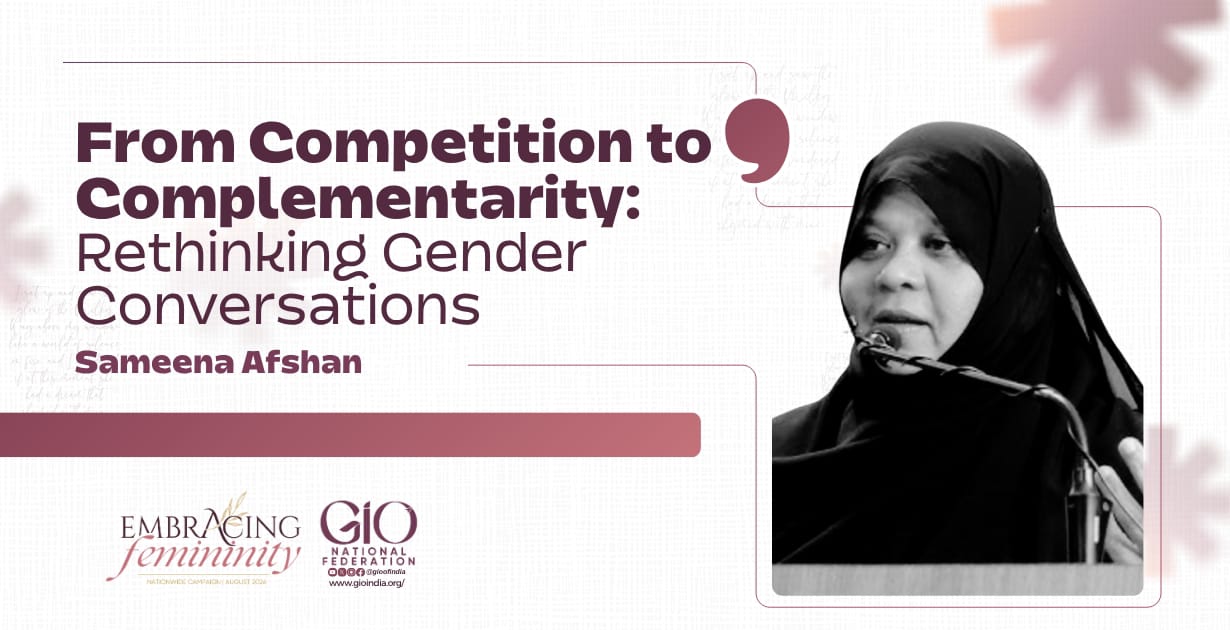
Sameena Afshan
Sameena Afshan is an educationist, writer and social worker. She is also the editor of Aura e-Magazine, a monthly women's magazine.